
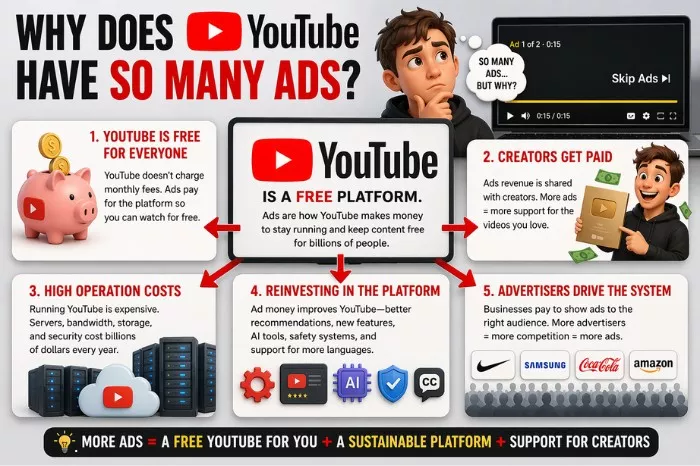
If you’ve tried to watch a simple three-minute tutorial lately and got hit with two unskippable ads at the start, plus a “Pause Ad” the second you stepped away to grab a coffee, you aren’t alone. Now the vibe on YouTube has shifted. It feels less like a quirky video site and more like the “new cable TV”—and with that comes the heavy-handed commercial load we all used to hate on broadcast television.
In 2025, YouTube’s ad revenue cleared $40 billion for the first time. That’s a massive jump from just a couple of years ago. But why the sudden “ad-pocalypse”? It’s not just corporate greed (though that’s a slice of the pie); it’s a mix of how we watch, who’s getting paid, and a very deliberate push to make you “pay up” for a subscription.
“Big Screen” Takeover
The biggest reason you’re seeing more ads is likely sitting in your living room. As of early 2026, YouTube officially owns the TV. It’s been the #1 most-watched “network” on television screens for years now, beating out giants like Netflix and Disney.
When you watch on a phone, you’re distracted. When you’re on a couch, you’re a “captive audience.” Google knows this. That’s why they’ve rolled out 30-second unskippable ads specifically for TV apps.
They’ve also introduced “Pause Ads”—so if you stop a video to take a call, a static ad pops up on the side. They’re basically turning your Smart TV into a billboard because, frankly, they know you probably won’t get up to find the remote just to skip it.
Feeding a $70 Billion Creator Beast
We love our favorite creators, but they’ve become expensive to keep. Over 110 million people are trying to make a living on YouTube now. To keep top-tier talent like MrBeast or the next big tech reviewer from jumping ship to TikTok or rival platforms, YouTube has to keep the checks coming.
Over the last two years, YouTube has paid out more than $70 billion to its creators. That money doesn’t come out of thin air. As production values go up—with creators hiring full film crews and editors—the “cost of doing business” rises. To keep those payouts high and the creators happy, YouTube has to cram more “ad inventory” into every single video.
“Pain Point” Strategy (The Premium Push)
Google wants you to stop watching for free. There’s a psychological game happening here. By making the free experience slightly more annoying every year, they’re nudging you toward YouTube Premium.
By 2026, Premium has hit over 125 million subscribers. It’s a goldmine for Google because it’s guaranteed monthly cash. The more ads they show you, the more likely you are to finally snap and say, “Fine, take my $15 a month’—unless you update your ad blocker regularly to avoid any disturbance and stay one step ahead.” It’s a classic “carrot and stick” move—and the “stick” (the ads) is getting a lot heavier.
Shorts Effect and AI
Then there’s YouTube Shorts. We’re now seeing over 200 billion views on Shorts every single day. Because these videos are only 60 seconds long, you’re swiping past an ad every three or four videos. This has trained our brains to accept a higher frequency of interruptions.
On top of that, YouTube’s AI has gotten scary-good at “predictive placement.” Now, the algorithm doesn’t just show random ads; it waits for “high-intent” moments. If you’ve been searching for new sneakers, the AI might dump three shoe ads into a single video because it knows you’re in a “buying mood.” It’s hyper-efficient, even if it feels intrusive.
Bottom Line
At the end of the day, YouTube is no longer the “broadcast yourself” startup of 2005. It’s a global media titan that supports millions of jobs. While the 2026 ad load feels like a lot, it’s the price we pay for “free” access to a library of nearly every video ever made.
But honestly? If you’re spending three hours a day on the platform, that “Skip Ad” button is probably starting to look like a relic of the past.
