
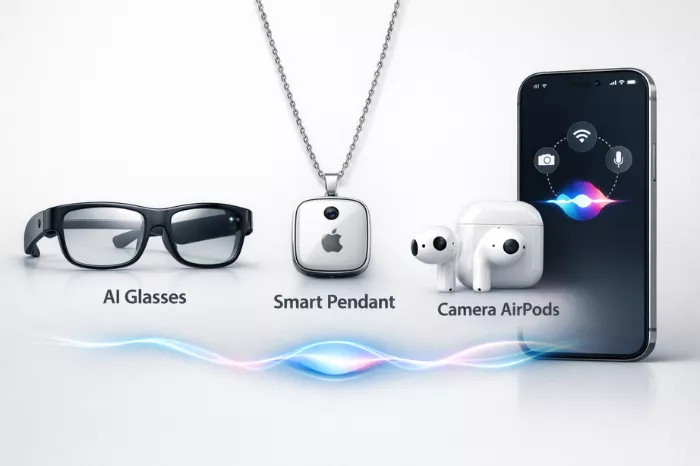
Apple is reportedly exploring new wearable devices that could change how we interact with AI in daily life. According to a report from Bloomberg’s Mark Gurman, the company is developing AI-powered glasses along with a small wearable “pendant” and camera-equipped AirPods that would allow users to talk to AI naturally throughout the day. All three devices will include built-in cameras and pair with the iPhone, enabling Siri to use “visual context” to understand surroundings and perform actions more intelligently.
If these devices become reality, they could represent Apple’s next big step in wearable technology and AI integration.
Moving Toward AI Wearables
Apple has already found huge success with the Apple Watch and AirPods. Now, the company appears to be focusing on AI-first wearables — devices designed to make AI assistance constant, natural, and hands-free.
Unlike the immersive experience offered by the Apple Vision Pro, the reported smart glasses are expected to be lightweight and practical for everyday use. Instead of focusing on advanced augmented reality visuals, they may prioritize voice interaction and real-world assistance.
This suggests Apple is aiming for usefulness and simplicity rather than futuristic features.
What the AI Glasses Might Do
While Apple has not confirmed features, reports suggest the glasses could:
- Respond to voice commands
- Provide real-time information
- Help with navigation and directions
- Read and summarize notifications
- Work seamlessly with Apple devices and AI tools
The goal is simple: give users helpful information without needing to look at their phones.
This approach fits into the growing idea of “ambient computing,” where technology quietly supports users without demanding attention.
The AI Pendant: A Tiny AI Assistant
Even more interesting is the reported AI pendant. This small wearable device would allow users to speak with AI anytime, without pulling out a phone or looking at a screen.
The idea is similar to new AI-focused devices introduced by companies like Humane, which aim to reduce screen time and make technology more natural to use.
Apple’s version would likely connect deeply with iPhones, AirPods, and iCloud, making it more useful within its ecosystem.
A pendant-style AI device could:
- Answer questions instantly
- Give reminders and updates
- Summarise emails and messages
- Control smart home devices
- Offer helpful suggestions during the day
If done well, it could feel like having a smart assistant always nearby.
Apple Isn’t Alone in the AI Wearables Race
Apple is entering a growing market. Meta has already introduced AI-enabled smart glasses through its partnership with Ray-Ban, while several startups are experimenting with screenless AI assistants.
This competition shows a clear shift in the tech world toward making AI easier to access without relying on smartphones.
Apple’s key advantage may be its ecosystem and strong commitment to user privacy. The company typically emphasizes on-device processing and data security — something many users value.
Why This Matters
If Apple launches these devices, they could change how people use technology by making AI:
- less dependent on screens
- more voice-driven
- smarter and more contextual
- integrated into everyday routines
Instead of opening apps and typing questions, users could simply speak and receive help instantly.
This could also create a brand-new product category for Apple, similar to how the Apple Watch expanded the iPhone experience.
When Could These Devices Launch?
There is no official announcement yet, and the devices are reportedly still in development. That means a release could be months or even years away.
However, Apple’s growing focus on artificial intelligence suggests the company is preparing for a future where AI plays a bigger role in daily life.
The Bigger Picture
Tech companies are racing to make AI more natural and accessible. Wearable devices may soon become the main way people interact with artificial intelligence.
If Apple succeeds, its AI glasses and pendant could help shift technology away from screens and toward real-time, conversational assistance.
For now, these reports offer an early glimpse into what could be the next evolution of personal technology — one that listens, understands, and helps without getting in the way.